Wednesday, April 16, 2008

Senator Leahy's Prior Bill on Patents Sought Compulsory Licensing For the Benefit of Third Countries: How Can Giving Away US Patents Strenghten Them??

Mr. President: Mr. President, I am today introducing a bill which can be the catalyst for saving the lives or improving the health of millions of families in impoverished nations.


In far too many nations, thousands of children die needlessly each month.


The concept of my bill – called the Life-Saving Medicines Export Act of 2006 -- is easy to summarize.


It allows U.S. companies to make low-cost generic versions of patented medicines for export to impoverished nations that face public health crises but cannot produce those life-saving medicines for themselves.


[IN OTHER WORDS, IT GIVES TO U.S. GENERIC COMPANIES THE PATENTS OF OTHER U.S. COMPANIES]


This bill is based on World Trade Organization agreements permitting nations with pharmaceutical industries to help nations in need.


[CORRECTION, THE BILL IS BASED ON A SELECTIVE INTERPRETATION OF THE WTO AGREEMENTS]


That WTO agreement was labeled by U.S. Ambassador Portman as “a landmark achievement that we hope will help developing countries devastated by HIV and AIDS and other public heath crises.”


Apart from the pressing need for this step in humanitarian terms, passage of this bill could go a long way in improving U.S. relations with large segments of the world’s population.


[IN OTHER WORDS, BY GIVING AWAY THE PRIVATE PROPERTY OF U.S. PATENT HOLDERS AS A MATTER OF FOREIGN POLICY, THE U.S. GOVERNMENT CAN IMPROVE THE U.S. IMAGE ABROAD]


On December 6, 2005, the Office of the U.S. Trade Representative announced that it “welcomes” efforts to “allow countries to override patent rights when necessary to export life-saving drugs to developing countries that face public health crises but cannot produce drugs for themselves.”


[PLEASE REMEMBER, SENATOR, THE OPERATIVE WORDS IN THAT QUOTED PASSAGE ARE "LIFE-SAVING DRUGS TO DEVELOPING COUNTRIES THAT FACE PUBLIC HEALTH CRISES" BUT CANNOT PRODUCE DRUGS FOR THEMSELVES"]


I am concerned, however, that the Administration has taken no steps whatsoever to begin to implement that agreement. No implementing legislation has been provided to the Hill. I was informed just today that the Administration has “no present plans” to propose legislation to implement that international agreement. I am disappointed with that answer but am pleased that the Administration expressed a willingness to work with me on this important effort. I will forward my bill to them later today.


Indeed, the World Health Assembly and the World Health Organization have adopted resolutions urging all WTO member nations with a generic capability to adopt laws that implement that agreement.


The World Bank recently issued a guide and model documents on how best to implement that international agreement. My bill follows their model.


Like a generation ago, infectious and parasitic diseases remain the major killers of children in the developing world. Many of these diseases -- measles, malaria, river blindness -- we can prevent or cure. But those countries still lack the public health systems and the vital medicines.


Every hour, more than 500 African mothers lose a child, mostly from diseases caused by contaminated water.


In some sub-Saharan countries, HIV infection rates range as high as a third of the adult population, and for this reason 35 percent of African children are at higher risk of death than they were a decade ago.


Despite these grim statistics, there is a brighter side.


We are far more aware today of how much our own health depends on what takes place half a world away. Whether it is AIDS, SARS, West Nile Virus, the Avian Flu, or some as yet unknown infectious disease, we are all at risk, and only an airplane flight away, from wherever the outbreak may occur.


[IS THERE 'FEAR' FACTOR' AT PLAY HERE? AND HOW MANY DRUGS FOR HOW MANY DISEASES DOES THE SENATOR HAVE IN MIND? THERE DOESN'T SEEM TO BE A LIMIT...]


Because of this new awareness, global health is finally recognized as an issue of national security.


It may seem obvious today, but even ten years ago it was not.


Health threats that once concerned only medical personnel, now receive the attention of the highest levels of governments.


We are supporting policies and programs to help the poorest countries conduct better surveillance and respond more quickly to protect their own people, and to prevent the spread of disease.


There is a great deal more we need to do. Today, 15 percent of the world’s people consume 91 percent of the world’s pharmaceuticals. The high price of many life-saving medicines -- medicines that we take for granted in this country -- is beyond reach for billions of the world’s most vulnerable populations.


President Franklin Roosevelt said: "The test of our progress is not whether we add more to the abundance of those who have much, it is whether we provide enough for those who have little."


[PRESIDENT ROOSEVELT WAS SPEAKING ABOUT IMPOVERISHED AMERICANS...]


Imagine if you, or a loved one, were dying and you knew the medicine to cure the disease exists and costs only a few dollars, but you have no way to get it or to pay for it. That is a reality for millions of people today.


Reports by UNICEF, UNAIDS, and Doctors without Borders clearly show that the high price of many life-saving medicines is a significant barrier to their availability in many very low income areas of the world. Indeed, the 4th Global Report of UNAIDS notes the extremely low rate of treatment for HIV/AIDS in those areas by pointing out that of the 5 to 6 million urgently in need of antiretroviral medicines, only some 400,000 were receiving them.


With respect to AIDS, a recent book by Philip Hilts called “Prescription for Survival” notes the importance of offering affordable medicines to populations of impoverished nations:


“It was said that the price of the drugs was killing tens of thousands . . . .”


Under my bill, U.S. generic manufacturers would be allowed to make generic versions of patented drugs without the consent of the patent holders.


Those patent holders would receive compensation in the form of a royalty payment under a so-called “compulsory license” and the generic companies would then be required to sell those less-expensive generic drugs only to least-developed or developing nations.


Use of a compulsory license occurs when Congress determines that there is an important need which should be addressed.


[SENATOR, SORRY TO SAY, YOUR DEFINITION IS OVERBROAD. WHAT COMPELLING AMERICAN PUBLIC HEALTH POLICY NEED IS AT STAKE HERE?? IS IT NOT FIRST NECESSARY TO DETERMINE THAT THERE IS A REAL PROBABLE HEALTH RISK (AS OPPOSED TO POSSIBLE HAZARD) TO AMERICAN CITIZENS POSED BY A HEALTH EMERGENCY IN SOME OTHER COUNTRY??? SENATOR, ARE YOU INVOKING INDIRECTLY THE EUROPEAN PRECAUTIONARY PRINCIPLE, AS A PRETENSE FOR THIS BIG GIVE-AWAY??]


For example, most Americans do not realize that their network television programs received by satellite or by cable are provided under a compulsory license. The program owners receive a royalty for their programs under a formula.
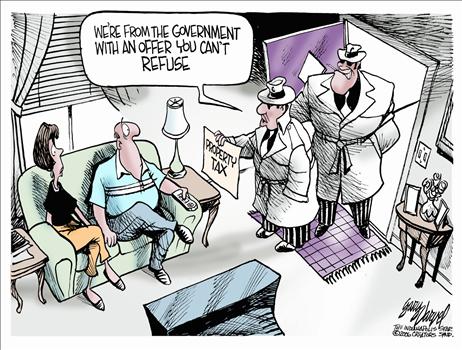

[SENATOR, DOES YOUR BILL PROVIDE FOR FULL, ADEQUATE AND JUST COMPENSATION FOR THE U.S. GOVERNMENT 'TAKING', WITHIN THE MEANING OF THE FIFTH AMENDMENT OF THE U.S. CONSTITUTION??? COULDNT' IT BE SAID THAT 28 U.S.C. 1498 APPLIES (NON-COMMERCIAL GOVERNMENT USE???) WE SURE HOPE SO, B/C IT WOULD REQUIRE THE U.S. GOVERNMENT TO PAY FULL, ADEQUATE AND 'JUST' COMPENSATION TO THE PATENT RIGHTS HOLDERS, ESPECIALLY SMALL INVENTORS!!]


This way American families can watch network TV programming over satellite or cable just like it is made available over-the-air. This same compulsory license approach, except with respect to patented medicines, is employed in this bill.


The WTO agreement contains language designed to protect the interests of the patent holders by focusing its benefits on areas of the world where these important medicines would not otherwise be available except for some of the wealthiest residents.


Thus, implementation of the agreement would not take business away from the companies owning the patents, sometimes referred to as the “brand-name” companies, since their medicines are not purchased by low-income families in those impoverished nations.


[THE BRAND NAME MEDICINES OF THE PATENT HOLDERS ARE NOT YET SOLD TO LOW-INCOME FAMILIES IN IMPOVERISHED NATIONS. WOULD THIS CHARACTERIZATION NOT MAKE IT EASY FOR THE BRANDED DRUG TO BE VIEWED AS PRETTY MUCH WORTHLESS IN THESE PARTICULAR MARKETS, SUCH THAT IT WOULD NOT COMMAND A HIGH ROYALTY RATE??? THE SENATOR'S BILL WAS THUS 'TAKE' THESE PATENT HOLDERS' PROPERTY FOR OTHER THAN AN AMERICAN 'PUBLIC USE'. SENATOR, CAN YOU PLEASE SHOW US WHERE, IN THE TEXT OF THE FIFTH AMENDMENT TO THE U.S. CONSTITUTION, OR IN U.S. CONSTITUTIONAL JURISPRUDENCE, IT SAYS THAT THE FIFTH AMENDMENT CONTEMPLATES FOREIGN PUBLIC USE AS FALLING WITHIN THE DEFINITION OF THAT PHRASE??]


In addition, the patent holders will receive royalties from the generic companies under the bill. Third, generic versions of products sold under the agreement have to be clearly marked as not for resale to developed nations. This will mean that the bill should not result in undercutting the high-priced sales of those medicines by the brand-name companies in developed nations.


[THE BILL WOULD NOT HAVE LIKELY AFFECTED THEN CURRENT SALES. BUT WHAT ABOUT FUTURE SALES??]


Thus, the bill addresses both the urgent needs of millions of low-income families in impoverished nations while protecting the interests of the patent owners of these life-saving medicines.


[SENATOR, WITH ALL DUE RESPECT, THAT IS AS INACCURATE A STATEMENT AS CAN BE MADE!!]


There have been significant voluntary efforts made by brand-name pharmaceutical companies, foundations, and non-profits who have donated life-saving medicines and have donated time, personnel and money to help in the fight against deadly diseases in other nations. I commend and greatly appreciate those efforts.


Some funding mechanisms have been started including the Global Fund to Fight AIDS, Tuberculosis and Malaria and President Bush’s Millennium Challenge Account. Nonetheless, much remains to be done.


If this bill is enacted it would complement the above efforts and implement the WTO agreements and make low-cost life-saving pharmaceutical products, and other medicines, available to hundreds of thousands of persons without other access to those products.


To provide a little history, I am very pleased that all the member nations of the World Trade Organization, WTO, agreed to this approach to assist people suffering from life-threatening diseases in least-developed or developing nations. Under this international agreement, nations such as the United States with pharmaceutical industries would be allowed to make and sell generic medicines to nations in need even if the patent owners of those medicines refused to authorize such manufacture and sale.


As I said earlier, On December 6, 2005, the United States announced that it “welcomes” the WTO amendment to “allow countries to override patent rights when necessary to export life-saving drugs to developing countries that face public health crises but cannot produce drugs for themselves.” The amendment will go in effect, for those nations which adopt it, once two/thirds of the member nations adopt it. The current waiver approach, allowing nations to implement it now, will remain in place until the permanent amendment is adopted. This permits that U.S. to move forward with this effort this year. Indeed, Canada has already passed implementing legislation.


[SENATOR, IF YOU HAVEN'T NOTICED, THE U.S. HAS NOT RATIFIED THAT WAIVER]


Participation by any nation which wants to export such generic products is voluntary. In order to participate, each country must pass legislation to implement the WTO agreement. The United States needs to act as soon as possible.


This is a moral issue. I am working with a number of religious groups, humanitarian organizations, international assistance groups, and generic drug companies on this effort. I have also received input from some pharmaceutical brand-name companies and hope a few will step forward and be leaders in this effort. I will also reach out across the aisle to try to form a bipartisan coalition.


[SENATOR, MORAL ISSUES JUSTIFY TAKING THE PRIVATE PROPERTY OF AMERICAN CITIZENS??? IS THAT WHAT 'PUBLIC USE' MEANS IN THE FIFTH AMENDMENT???]


Two recent World Health Organization annual reports, the World Health Reports for 2003 and 2004, demonstrate the enormous scope of the need for supplying these medicines to needy countries. The “Life-Saving Medicines Export Act of 2006” that I am introducing today would allow the U.S. generic industry to respond to these urgent international needs and could save millions of lives in impoverished nations.


Canada, Norway and the Netherlands have already enacted such legislation or rule changes. However, aspects of the Canadian law have been an impediment to the willingness of generic companies to participate. For example, that law allows Canadian generic companies to provide such medicines for at most only four years. The Canadian version permits dilatory and needless litigation, omits important medicines from a complex list of covered drugs, and creates unnecessary bureaucratic hoops.


[THESE COUNTRIES DO NOT HAVE THE U.S. CONSTITUTION AND ITS FIFTH AMENDMENT AS SAFEGUARDS FOR INDIVIDUAL PROPERTY RIGHTS INTERESTS]


I have received input from generic companies and my bill addresses all of those concerns. For example, it would provide that a participating generic manufacturer could provide such medicines for up to fourteen years which makes it much more likely that U.S. generic companies would make the investments needed to make low-cost medicines for export to impoverished areas.


[SENATOR, HOW MUCH EACH YEAR, IN CAMPAIGN AND OTHER $$$, DO YOU RECEIVE/ACCEPT FROM GENERIC DRUG COMPANIES???]

Under my bill, U.S. generic manufacturers would be allowed to make generic versions of patented drugs without the consent of the patent holders. Those patent holders would receive compensation, a royalty payment, under a so-called “compulsory license” and the generic companies would then be required to sell those less-expensive generic drugs only to least-developed or developing nations.


[SENATOR, LEAST-DEVELOPED COUNTRIES ARE DIFFERENT FROM DEVELOPING COUNTRIES. YOU USED THE TERM 'IMPOVERISHED NATIONS'. WHICH ONES ARE YOU REALLY REFERRING TO???]


The WTO agreement contains language designed to protect the interests of the patent holders by focusing its provisions on areas of the world where these important medicines would not otherwise be available except for some of the wealthiest residents. Thus, implementation of the agreement would not take business away from the companies owning the patents, sometimes referred to as the “brand-name patent holders since their medicines are not purchased by low-income families in those impoverished nations. There may be de minimis losses of profits for brand-name patent holders but certainly the humanitarian and self-interest benefits provided by the bill would massively outweigh those concerns.


[SENATOR, THAT IS MIGHT GENEROUS OF YOU TO DECIDE THAT THE PRIVATE INTERESTS OF U.S. PROPERTY HOLDERS MUST YIELD TO OTHER THAN AMERICAN PUBLIC HEALTH INTERESTS]


In addition, the patent holders will receive royalties from the generic companies under the bill. Third, generic versions of products sold under the agreement have to be clearly marked as not for resale to developed nations. This should mean that the bill will not result in undercutting the high-priced sales of the patented medicines in developed nations. Re-exporting of these generic products is prohibited unless it is part of a regional trade alliance among impoverished nations as permitted under the WTO agreements.


[SENATOR, HOW WILL THAT WORK?? IT ALREADY HAPPENS WITH DRUGS SHIPPED BACK INTO THE UNITED STATES FROM CANADA???]


Thus, the bill addresses both the urgent needs of millions of low-income families in impoverished nations while protecting the interests of the patent owners of these life-saving medicines and will hopefully help enhance America’s image in the world.


[IS THIS THE 'PUBLIC USE' THAT JUSTIFIES THE U.S. GOVERNMENT 'TAKING' AMERICAN'S PRIVATE PROPERTY - IMPROVING THE AMERICAN IMAGE ABROAD???]


For those only interested in self-interest rather than humanitarian aid, note that because of the globalization of travel our nation is at risk from failure to contain diseases in other nations.


[NO SENATOR, OUR NATION FACES A POTENTIAL HEALTH HAZARD DUE TO GLOBALIZATION OF TRAVEL, NOT A PROBABLE RISK. LET'S BE CLEAR ABOUT THE NEED TO SPECIFY FACTS AND CIRCUMSTANCES]


America has a strong self-interest in combating diseases in foreign nations. A surprising number of new diseases have emerged in recent years. Some of these new diseases are variations of existing diseases. The volume of people and cargo going to and from distant nations is astounding. According to “Rx for Survival” by Philip Hilts, if you count only travel between nations with a heavy burden of disease and those with less disease, more than a million people a week are making the trip.


The more viruses and bacteria mutant inside animals and people, and the more people and goods travel throughout the world, the more residents living in the United States are at risk of being harmed by dangerous diseases.


The National Intelligence Estimate of January, 2000, published by the CIA and the National Intelligence Council noted that: “New and emerging infectious diseases will pose a rising global health threat, and will complicate U.S. and global security over the next 20 years. These diseases will endanger U.S. citizens at home and abroad, threaten United States armed forces deployed overseas and exacerbate social and political instability in key countries and regions.”
I hope all my colleagues will join me in supporting this effort. Here is my section-by-section summary of the bill.

Section 1: Sets forth the name of the Act as the “Life-Saving Medicines Export Act of 2006.”


Section 2: States that the purpose of the Act is to promote public health under World Trade Organization agreements by permitting the export of generic versions of life-saving patented pharmaceutical products and other medicines including diagnostic tools and vaccines needed to prevent or treat potentially life threatening diseases to residents of impoverished countries with insufficient or no manufacturing capacity to make the medicines. The findings set forth determinations by the World Health Organization concerning the millions of low-income persons without regular access to medicines in lesser-developed or developing nations.


Section 3: This section requires the Director of the United States Patent and Trademark Office to issue a compulsory license (permission to make and sell a patented product under this new Act) to permit generic companies to make and export medicines under the terms of WTO international agreements under several conditions.


The recipient country must be a least-developed nation, as defined by the United Nations, or a developing nation without the ability to manufacture the medicine in question.


[THIS DEFINITION WOULD COVER VERY MANY COUNTRIES. LIKE THE DOHA DECLARATION, IT SHOULD NOT COVER THE 'BRIC' NATIONS OF BRAZIL, RUSSIA, INDIA OR CHINA]


The recipient country, called an “eligible country” in the bill, must notify the WTO of its interest in participating in this program.


Efforts must have been made by the generic company to buy the right to make and sell the medicine under normal business arrangements with the patent holders.


[WHAT INCENTIVE DO GENERIC COMPANIES HAVE TO 'BUY' THE RIGHT AT A MARKET PRICE, IF THE U.S. GOVERNMENT WILL COME IN AND DETERMINE THE PRICE IF THERE IS NO AGREED UPON PRICE??]


The medical product exported under this Act must be for life threatening public health problems and can only be used in least-developed or developing nations, and is not for re-export except in identified circumstances relating to regional trade alliances.


[SENATOR, HOW DO YOU SQUARE THIS DEFINITION WITH THAILAND'S DECISION TO ISSUE COMPULSORY LICENSES AGAINST BRAND NAME HEART (HIGH BLOOD PRESSURE MEDICINES AND CANCER DRUGS - ARE THEY 'PUBLIC HEALTH PROBLEMS', TOO?? HOW MANY DISEASES ARE YOU REFERRING TO??)]


Special labeling and packaging must be used to make clear that the product is sold under the authority of the WTO agreement only for use as allowed under agreement and this bill.


[SENATOR, WHERE ARE THE ENFORCEMENT PROVISIONS WITHIN YOUR BILL?? IS THERE ANY PROVISION FOR CRIMINAL PENALTIES FOR MISLABELING AND SMUGGLING BRAND NAME DRUGS INTO PARALLEL DEVELOPED COUNTRY MARKETS??]


The permission to make and sell the product, the license, can not exceed seven years, except that the license may be extended once.


The holder of the compulsory license shall pay a royalty to the patent holder, as determined by the Director of the PTO within a limited range of possible rates set forth in the bill, taking into account such factors as humanitarian needs, the economic value to the importing nation, and the need for low-cost pharmaceutical products by persons in the importing nation.


[SENATOR, THIS PRETTY MUCH DRIVES DOWN THE U.S. GOVERNMENT DETERMINED PRICE OF THE PATENTED BRANDED DRUG TO WAY BELOW NORMAL U.S. MARKET PRICES - TO PERHAPS LESS THAN A 1% ROYALTY RATE, AS DEMANDED BY HEALTH ACTIVISTS. IN OTHER WORDS, SENATOR, YOUR BILL CALLS FOR THE GIVE-AWAY (ESSENTIALLY A FORCED GIFT) OF PRIVATE U.S. CITIZENS' PROPERTY TO A THIRD NATION - THIS VIOLATES THE U.S. CONSTITUTION AND THE FIFTH AMENDMENT OF THE BILL OF RIGHTS!!]


The maximum royalty for any shipment shall not exceed 4 percent times the commercial value of the pharmaceutical products to be exported under this Act under that supply agreement.


An alternative royalty payment approach, modeled after the approach enacted into law by Canada, would also be permitted with the same 4 percent maximum. In addition, the Director may accept combined applications from multiple eligible countries. Note that in emergency situations the Director may waive provisions of the bill in a manner consistent with the WTO agreements.


Section 4: This section makes clear that compulsory licenses issued under this Act shall not be considered an infringement of a patent.


Section 5: This section creates a diverse advisory board of academic, patent, trade, medical, international aid, and industry experts to advise the Director, and to report to the Congress, on ways to improve implementation of the bill to achieve its purposes. Mandatory funding for the board is provided out of the general fund of the U.S. at $1.5 million in fiscal years 2007 and 2008, with modestly declining amounts provided in subsequent years through 2011.

Tuesday, April 15, 2008

The Leahy-Spector Patent Reform Standoff

http://www.ip-watch.org/weblog/index.php?p=1007


Intellectual Property Watch

15 April 2008


US Patent Reform Stalls as Senate Negotiations Break Down

[THE LEAHY-SPECTER STANDOFF]


By Dugie Standeford for Intellectual Property Watch


United States Senate negotiations on sweeping reform of the patent system foundered late last week as ongoing disputes over key provisions - and possible squabbling over confirmation of federal judges - resulted in S 1145 being pulled from the floor schedule for the time being.


“We are not going to do a patent bill now,” said Senate Majority Leader Harry Reid, Democrat- Arizona [NEVADA], because the chairman and ranking member of the Senate Judiciary Committee cannot agree on the text, he said on 10 April.


But while prospects for the bill’s immediate passage have dimmed, it is not yet dead, observers said.


Judiciary Committee Chairman Patrick Leahy, Democrat-Vermont, intended to announce that a revised version of the measure would be brought to the Senate floor this week, the Intellectual Property Owners Association reported last Friday.


The plan derailed when Leahy failed to agree on several provisions with the panel’s ranking member (lead of the opposing party), Senator Arlen Specter, Republican-Pennsylvania.


“The principal sticking point is the issue of how to assess damages in patent infringement lawsuits,” Specter said on 9 April. The lawmakers thought they had reached agreement, but “the language continued to shift, so we do not yet have a deal on the package,” he added.


The current draft allows damages of “no less than a reasonable royalty” calculated on either the entire market value of the invention, an established royalty based on marketplace licensing, or the proportional contribution of a patented component. Judges and juries must establish an invention’s “specific contribution over prior art” to gauge the actual harm of an infringement. The provision is unpopular with some patent organisations, labour unions and others (IPW, US Policy, 18 March 2008).


Specter said later, as reflected by the Congressional Record, that some in the Republican Party want to hold up S 1145 to pressure Democrats to confirm several judicial nominations. A Democratic Judiciary Committee aide told Intellectual Property Watch that five were approved last week.


Specter’s earlier comments drew criticism from Leahy, who complained that “just a handful of words” had stalled work on a key piece of legislation. The time for patent reform is now, Leahy said. “Unfortunately, some have yet to fully grasp this fact.”


Industry Reaction Muted


Efforts to revamp the US patent system have split the biotechnology and high-tech industry sectors, with the former strongly opposed to many of the changes sought by the latter. Reaction to the stalemate was predictable but muted, with most groups saying they will continue to work toward comprehensive reform.


Leahy is “right to stand firm for meaningful reform” on damages, said Mark Isakowitz, coordinator for The Coalition on Patent Fairness, which represents telecommunications, energy, banking, retail, computer, software and other high-tech sectors. The bill’s sponsors and supporters have made many compromises to address the concerns of critics “who refuse to budge an inch” on the issue, he said.


The Coalition for 21st Century Patent Reform, whose members include companies from the chemical, pharmaceutical and other industry sectors, praised Leahy’s and Specter’s efforts so far and said it hoped a consensus would be reached.


The Biotechnology Industry Organisation said Specter was “right to reject” revisions which jeopardise many economic sectors that rely on strong patent protection.


“Serious issues remain to be resolved,” but “solving damages is the real key to whether this bill moves,” said a spokesman for the Innovation Alliance, whose members are technology companies and patent holders in various sectors.


There are other major problems as well, said Hayden Gregory, IP law consultant in the American Bar Association’s governmental affairs office. Senator Orrin Hatch, Republican-Utah, “is very insistent upon reform of inequitable conduct [improprieties in applying for a patent], and Leahy is very resistant to that,” he told Intellectual Property Watch.


The US Patent and Trademark Office is pushing hard for “Applicant Quality Submissions,” which is “code-speak for a requirement that applicants do a patent search for every application and explain the significant results as part of the application,” Gregory said. Inventors and IP lawyers strongly reject the proposal, not least because “users of the patent systems are paying $2 billion a year so that the USPTO can provide such services,” he said. Offloading the cost to patent-seekers will hike each application fee by $10,000 to $15,000 according to the Congressional Budget, he said.


“Too Early” to Predict Outcome


S 1145 “certainly is not dead” but whether there will be a patent reform law this year is “too close to call,” said Foley & Lardner patent attorney Harold Wegner.


Suspensions of negotiations on legislation are common, so it is “far too early to pronounce” S 1145 dead for the year, the IPO said.


The continuing controversy could keep the bill off the Senate floor for the next few weeks, said the Innovation Alliance spokesman. That will “hopefully allow for a serious negotiation among all stakeholders,” he said.


Separately, the American Civil Liberties Union (ACLU) earlier this month urged a federal court to uphold the denial of a patent for an abstract idea. The applicant sought to patent the concept that the “weather risk” involved in buying and selling commodities could be reduced if sellers had conversations with two buyers instead of one, the ACLU said. Patenting speech or thought risks violating the First Amendment guaranteeing freedom of speech, the organisation said.


Dugie Standeford may be reached at info@ip-watch.ch.

Friday, April 4, 2008

Academic and Healthcare Activists Secretly Discuss Possible Thai Compulsory Licensing Pricing Strategy to Undermine USTR/PhRMA


The following colloquy took place during April 1-4, 2008, between James Love of Knowledge Ecology International (KEI), a George Soros-funded health and human rights activist group, and several left-leaning US, UK and Australian university professors:


Northeastern University Professor Brook Baker, Boston University Professor Kevin Outterson, Cleveland State Univ. College of Law Professor Michael Davis, London School of Economics Professor Ken Shadlen, Australia National University Professor Peter Drahos and an anonymous professor who identifies himself by the pseudonym "Miles Teg" (Miles Teg is a fictional character in the Dune universe created by Frank Herbert... Miles Teg was a military genius and became Supreme Bashar of the Bene Gesserit, winning many victories. He had a very strong sense of honor, loyalty, and had the many characteristics of House Atreides. He is well known for doing the unexpected. See Wikipedia, at: http://64.233.169.104/search?q=cache:bF17aBEckDcJ:en.wikipedia.org/wiki/Miles_Teg+Miles+Teg&hl=en&ct=clnk&cd=1&gl=us ).
------------------------------------------------------------------------------------------------

http://lists.essential.org/pipermail/ip-health/2008-April/012421.html


B.Baker@neu.edu mailto:B.Baker%40neu.eduTue Apr 1 11:07:01 2008


I think there are four interest facets of the U.S. statement in the Thai NTB report (reprinted below).


"Thailand's Ministry of Public Health has issued compulsory licenses on certain patented drugs. The United States acknowledges Thailand's ability to issue compulsory licenses to address public health emergencies, subject to Thailand's domestic and international legal obligations as a WTO Member. At the same time, the United States has expressed concern regarding a lack of transparency in the process and about the potentially expansive use of compulsory licenses. The United States has urged Thailand to address judiciously the complexities of the relationship between health and intellectual property policy and to do so in ways that recognize the role of intellectual property in the development of new drugs."


1. The U.S. continues to misinterpret the circumstances where compulsory licenses can be issued, suggesting that they are appropriate only to respond to public health emergencies.


2. The U.S. continues to suggest that the licenses were issued in a non-transparent manner, thereby failing to acknowledge the protracted negotiations that preceded the 2006-07 licenses on efavirenz, clopidrogel, and lopinavir/ritonavir and the even more intensive consultations that preceded the issuance of the four cancer CLs in 2008.


3. The U.S. adds a new concern, namely that the use of compulsory licenses will become "potentially pervasive." Of course, Thailand has been careful to set up a stringent screening process, has established strict needs-based standards, and has issued CLs on only a tiny portion of the medicines patented in Thailand.


4. Finally, the U.S. has used relatively muted language and has not in any sense "signalled" an intention to identify Thailand as a Priority Watch Country, despite earlier publicity about this possibility.


Jamie Love has previously suggested that Thailand (and perhaps other middle-income countries) could address the stated U.S. concern about "contributing to the development of new drugs" by revising upwards the royalty rate on its compulsory licenses (currently ranging from .5%-5% on the generic price). Although international compulsory licensing practice and commercial practice support royalty rates in this range, it is important to note that commercial royalty rates are ordinarily based on sales at monopoly prices, resulting in much higher absolute payments per pill.


Even though it is by no means required to do so, Thailand could gain credibility with U.S. Congressional leaders and undermine USTR/PhRMA attacks, by offering an additional, and perhaps targeted R&D royalty. One idea would be to target the royalty to type-I and type-II (neglected) diseases affecting the Thai population. If the affected drug company were willing to accept the additional royalty on this basis, the R&D could be done anywhere. However, an even better alternative would be that the targeted research be conducted in Thailand in universities, research institutes (if any), or even in the GPO. Agreements would need to be reached in advance about the eventual co-ownership/marketing of innovative products, but this kind of targeted research could entail technology transfer, building of research capacity, and perhaps even expansion of pharmaceutical capacity in Thailand.


There are risks in such a proposal, including that the standard royalty rate will be higher and that fewer patients will be treated from the same health budget, but there may be political advantages from indicating a willingness to pay a little more for innovative R&D as long as it focuses on developing country needs.


Brook

Professor Brook K. Baker, Health GAP
Northeastern U. School of Law
Program on Human Rights and the Global Economy
400 Huntington Ave.
Boston, MA 02115
617-373-3217 (office)
617-259-0760 (cell)


-------------------------------------------------------------------------------------------------

http://lists.essential.org/pipermail/ip-health/2008-April/012424.html


mko mailto:mko%40bu.eduWed Apr 2 06:26:04 2008


I agree that middle-income countries should explore higher royalty rates on generically-priced drugs sold under a CL. Doing so wouldn't harm access much; indeed if the higher royalty reduced opposition from USTR & IFPMA, then access could be dramatically improved. I've tried to model these CL royalties or patent buy-outs from the opportunity cost in R&D from the foregone revenues:

http://papers.ssrn.com/sol3/papers.cfm?abstract_id=873402


Kevin Outterson
Boston University

Boston University School of Law
765 Commonwealth Ave., Boston MA 02215
617 353 3103
http://ssrn.com/author=340746

-------------------------------------------------------------------------------------------------

http://lists.essential.org/pipermail/ip-health/2008-April/012428.html


Miles Teg mailto:b.miles.teg%40gmail.comWed Apr 2 09:20:02 2008


Why should developing countries reduce their legal flexibility to determine royalty rates by such "self regulation"? Is it a realistic that opposition to CLs in developing countries would reduce?


bmt

-------------------------------------------------------------------------------------------------

http://lists.essential.org/pipermail/ip-health/2008-April/012429.html


michael.davis@law.csuohio.edu mailto:michael.davis%40law.csuohio.eduWed Apr 2 09:54:00 2008


There is no reason for them to do that. It is a classic trap, the kind of advice you would give to a prisoner at Guantanamo ("Behave and we won't torture you.") It also smacks too much of the unstated "Trust me," which is never advice you should take from an adversary.


Mickey Davis

-------------------------------------------------------------------------------------------------

http://lists.essential.org/pipermail/ip-health/2008-April/012431.html


B.Baker@neu.edu mailto:B.Baker%40neu.eduWed Apr 2 14:47:10 2008


Miles and Mickey have raised sensible questions about whether it is politically wise to raise royalty rates in the hopes of encountering less resistance from patent holders and their governmental proxies in the USTR and European Union. It may well be that there is no real appeasing of opponents to lawful utilization of TRIPS-compliant compulsory licenses - that they will always use disinformation and misinformation to challenge CLs and whatever royalties are paid.


Evidence of such continuing opposition can be found in the still strident attacks against Thailand's recent compulsory licenses on cancer drugs, even though Thailand raised the royalty rate from .5% to 5%.


All that Article 31 of the TRIPS Agreement requires is that "the right holder shall be paid adequate remuneration in the circumstances of each case, taking into account the economic value of the authorization." This clause gives wide latitude to governments to assess the circumstances and the economic value of the license. As Jamie Love's detailed study of
remuneration rates showed, countries can make such choice by weighing factors or pursuant to percentage royalty guidelines, so as long as individual determinations are made in each case.


However, contrary to Miles' and Mikey's critique, I think it is useful for ATM activists to speculate about royalty rates that "might" reduce political opposition and about royalty schemes that might actually increase research and development into neglected diseases and/or spur increased R&D activity in developing countries. There is no presumptively "polically correct" royalty rate, and Thailand engaged in a politically astute, self-determined decision to raise its royalty rate on the new cancer CLs. Did they do so as Guantanamo prisoners or as colonial subjects - I think the suggestion is a little insulting.

Professor Brook K. Baker, Health GAP
Northeastern U. School of Law
Program on Human Rights and the Global Economy
400 Huntington Ave.
Boston, MA 02115
617-373-3217 (office)
617-259-0760 (cell)

-------------------------------------------------------------------------------------------------

http://lists.essential.org/pipermail/ip-health/2008-April/012433.html


mko mailto:mko%40bu.eduWed Apr 2 14:47:32 2008


I'm sure I've been misunderstood here.


My point is simply that CL, while entirely legal under TRIPS, is politically difficult given the sustained attack by USTR and big phrma. Modifying the royalty structure might take away one argument in their quiver: "CL will destroy innovation!"


I'd describe it as disarming your opponents by being reasonable.


Having said that, being reasonable with phrma doesn't have a great track record.


Kevin Outterson
Boston University

-------------------------------------------------------------------------------------------------

http://lists.essential.org/pipermail/ip-health/2008-April/012434.html


James Love mailto:james.love%40keionline.orgWed Apr 2 15:34:01 2008


My view regarding royalty rates and trade pressures is that royalty payments that are too low will be considered unreasonable, and will not be politically sustainable. As a matter of some recent history, I did not want to defend a .5 percent royalty rate, applied to generic prices, and I don't think it helped the countries that choose that rate. Even if people don't understand much about this topic, .5 percent sounded pretty low.


The more recent higher royalty rates in Thailand have I believe made it easier to Thailand to keep the new compulsory license. Even more important, of course, have been the actions of the Thai activists, who have done the really important work in pushing the Thailand government
to protect consumer interests.


In the longer run, we think that governments in developing countries should simply set aside an appropriate fraction of health or drug purchase budgets, to reward drug developments, and de-monopolize all drug purchases. Some people in the Thai government have suggested doing this, and there is a discussion about whether or not this is a better business model for the Global Fund and other donor funded drug purchases. Agree on how much money goes to innovators, and then buy everything at marginal cost, increasing access and improving outcomes.


Once the negotiation turns to the fraction of the drug budget that goes to innovators, and marginal cost pricing of products is accepted, you can begin to have a rational policy discussion.


Jamie

-------------------------------------------------------------------------------------------------

http://lists.essential.org/pipermail/ip-health/2008-April/012435.html


Peter Drahos mailto:peter.drahos%40anu.edu.auThu Apr 3 08:10:02 2008


I do not believe that upping the royalty rate will reduce the pressure on countries like Thailand. During the Uruguay Trade Round, the US made a lot of promises about backing off on its trade unilateralism if developing countries signed up to the WTO, TRIPS and its jolly nice dispute resolution mechanism. The FTA IP jihad followed soon after. I also think there may be cases where .5% will be appropriate. Hard to see how a country like Laos can afford much more.


Of course, this Thai saga has in part been about sending a message to other countries in the region about what to expect if they exercise their lawful rights =AD Al Capone and the boys are
gonna pay you a visit and now there=92s a minimum rate you can=92t go below=.


Chomsky somewhere has a nice line about domination in the world today =AD =93the rule of law
for the weak, the rule of force for the strong=94


Peter Drahos

-------------------------------------------------------------------------------------------------

http://lists.essential.org/pipermail/ip-health/2008-April/012437.html


James Love mailto:james.love%40keionline.orgThu Apr 3 10:40:03 2008


There is no doubt that there is plenty of bullying, lying, angling for industry jobs after leaving the government, and other mean spirited stuff going on here.


Even so, Thailand has benefited at least somewhat from interventions from some sympathetic members of the US Congress and government (and the European Parliament and EC), and this has and I hope will continue to moderate somewhat the full brunt of the fury that PhRMA would like to see unleashed. To this end, the .5 percent royalty rate was unhelpful, bad PR, and almost completely unnecessary in terms of the policy.


To make things more concrete, the price of Plavix dropped from 77 to 1 baht once competition was introduced. A royalty of .5 percent of 1 baht was .005 baht per pill, or 1.825 baht per year, equal to about 6 US cents at current exchange rates. A 5 percent royalty, 10 times as high, would have been a royalty of 18.25 baht per year or 58 US cents, per year.


The price of Plavix before the CL was $888 per year. After the CL, it was $11.53 per year. Arguing about 6 cents versus 58 cents is losing sight of the big picture, I think.


Jamie

----------------------------------------------------------------------------------------------------------

http://lists.essential.org/pipermail/ip-health/2008-April/012447.html


Ken Shadlen mailto:k.shadlen%40lse.ac.ukFri Apr 4 18:04:02 2008


But if the difference between the amount per unit that goes to the originator firm whether the royalty rate is .5% or 5% is so tiny as to be nearly insignificant from the government's perspective, which is what I'm reading here in Jamie's post, then wouldn't it also be insignificant to PhRMA? I see the point about not wasting energy wrangling about 6 cents vs. 58 cents, but I can't see how this would reduce the backlash. To the contrary, I think Jamie has presented a pretty good argument as to why a CL with 5% -- even higher -- would still leave PhRMA far from satisfied in the context of a reduction of ~$775/unit.

I write this without being in Washington or having close daily contact with Washington. Are there people in Congress (or USTR) that would be more sympathetic to the Thai government were they paying .58/unit rather than .06/unit?

Ken


-------------------------------------------------------------------------------------------------


http://lists.essential.org/pipermail/ip-health/2008-April/012448.html


James Love mailto:james.love%40keionline.orgFri Apr 4 23:05:03 2008


The reduction is per unit of sales. But note also that sales were approximately zero for the bottom 80 percent of the population.


... First off, PhRMA is focused on maintaining the monopoly. In Malaysia, where the "government use" CL proposed a 4 percent royalty, GSk didn't even want to take the money. They thought it would signal an acceptance of and legitimacy for the CL. In some cases, when a country was serious about a CL, the patent owner announced they would give away the drug, to undermine efforts to issue a CL. This was the outcome of the fluconazole case in South Africa, for example. PhRMA is entirely devoted to opposing the use of CLs, because they want to a monopoly, and they believe a monopoly will lead to higher profits than government set royalty payments, and they see each of the CL cases as setting precedents for the future.


Thailand and other countries feel some pressure from PhRMA members, but the biggest pressures come from governments in the North, particularly from the US and the EC and the EU member states. While it may seem so at times, governments in the North do not take their instructions verbatim from the patent owners. The US and the EC have much broader interests and concerns, and the demands of the PhRMA companies are part of a larger calculus that also includes non-PhRMA trade with Thailand and other countries, and genuine concern about the poor in developing countries. If the USTR or DG-Trade goes ballistic in demanding high prices for life saving drugs in Thailand, it can't exactly expect to achieve all of the other demands it might want to make, to address the concerns of other US or EU companies. USTR and DG-Trade spend a fair amount of time fighting off PhRMA lobbying, so they can address the broader trade agenda (which is why we have the 2001 Doha Declaration). In this respect, something like the royalty rate becomes relevant, because it is used in the EU and the US Congress as evidence one way or another that Thailand is acting reasonably.


The Average US royalty rates are probably close to 5 percent, and in fact, that is the number used in some PhRMA submissions to USTR. And profit rates in competitive sectors of the economy probably run around 3 to 5 percent. In this respect, royalties of 3 to 5 percent seem, on their face, pretty reasonable, to a lot of people. Royalties of .5 percent seem pretty low, particularly to hill staffers and others who have little time for detailed economic analysis of the Thai pharmaceutical market.


Our own work on royalties has been more nuanced and sophisticated than this, and in the 2005/WHO/UNDP Tiered Royalty Method (TRM), I recommended a system of royalty setting that is based upon a percentage of the putative value of the medicine in high income countries, adjusted for the relative income of the countries where it is consumed. This is conceptually an appealing way for setting royalties in developing countries, but because it is novel and more complicated than simply using a percent of the generic price, it has not been used.


In general, however, it may be easier just to simplify everything even more, and link the de-monopolization of the drug sector (for marginal cost pricing of products), with a system of rewards for drug developers that is pegged to some fraction of the drug purchase budget or health care budget. The political demand from developing country governments and consumer groups would be to ensure access through marginal cost pricing of products, while conceding the legitimacy of a separate argument over the amount that a country gives to innovators. I think this is an argument that can be won, and it can be the basis for a sustainable long term change in the business model for paying for innovation. The rewards to innovators could be rationally linked to the impact of products on improvements in health outcomes. The more the "ask" makes sense (and is perceived to make sense) in terms of the legitimate interests of both consumers and drug developers, the higher are the odds of really changing things.


Jamie

Will Large US Hi-Tech Companies Use Proposed Patent Reforms to Undermine American Labor and Trigger Further Job Losses???

http://hosted.ap.org/dynamic/stories/P/PATENT_REFORM_UNIONS?SITE=VASTR


Unions pounce on patent reform


By CHRISTOPHER S. RUGABER


AP Business Writer


WASHINGTON (AP) -- The battle over patent reform, a sleepy sounding subject that affects new, cheaper medicines, Chinese counterfeits and BlackBerry addicts, has always sent high-tech companies and drugmakers to their respective corners.


But now organized labor is getting in the fight, using its lobbying muscle to stop - or at least shape - proposed changes to patent law.


Spurred by concern of overseas piracy of U.S. goods, unions have stepped up their opposition to patent reform legislation pending in the Senate. [A copy of the fax sent by these unions to the U.S. Senate is accessible at: http://anticipatethis.files.wordpress.com/2008/02/fax-from-union-on-patent-reform-2007.pdf .


The AFL-CIO and the Change to Win coalition, a group of seven unions that includes the Teamsters, [ http://www.changetowin.org/ ] argued in separate letters recently that proposed reforms to the patent system would make it easier for competitors in China and India to counterfeit U.S. products and send more U.S jobs overseas.


Labor's opposition puts Senate Democrats who support the measure in a tight spot. Patent reform is a top priority for another Democratic constituency: high-tech companies such as Hewlett-Packard Co. and Cisco Systems Inc.


The patent bill, sponsored by Sens. Patrick Leahy, D-Vt., and Orrin Hatch, R-Utah, would make the first significant changes to the U.S. patent system in more than 55 years. It has deeply split the business community and ignited intense lobbying.

Computer and Internet companies gave $1.3 million, 57 percent of their total federal contributions, to Democratic candidates in 2007-2008, according to the Center for Responsive Politics. Their contributions are dwarfed by organized labor, which has given more than $24 million in the same period, 90 percent to Democratic candidates.


Labor's opposition has "captured lawmakers' attention," said Robert Lindefjeld, a patent attorney at Jones Day, because they have demonstrated a link between the otherwise complex and obscure issue of patent reform and jobs. In an effort to placate unions and other opponents, Leahy and other senators are scrambling for a compromise.


A Senate aide, who requested anonymity, said, "There's a lot of interest groups involved ... It's difficult to address everyone's concerns so that they're 100 percent happy with the outcome."


The compromise proposal could be released as soon as this week, several lobbyists said. The House approved its version of the bill last September.


One of the most contentious issue is the calculation of damages in patent infringement suits. High-tech companies, whose products may include hundreds of patented parts, want awards more closely tied to the specific patent that was infringed, rather than to the entire value of the product.


Opponents say that would reduce damage awards and make it easier to infringe patents. One possible compromise in the works would give judges more discretion to provide guidance to juries on calculating damages.


The unions oppose the current damages provision and a measure that would require the publication of patent applications within 18 months of submission, which they fear would make it easier for overseas competitors to copy U.S. inventions.


They received an unlikely boost last fall when a Chinese official, Yongshun Chen, a former judge, was quoted in the Chinese press as saying reform legislation "favors the infringers and burdens patentees more." [This letter is accessible at:

http://infringement.blogs.com/philip_brooks_patent_infr/files/patent_reform_article_china_intellectual_property_news.pdf

An excerpt from the letter states the following:

[I]n general the bill favors infringers and burdens patentees more. It is not bad news for developing countries which have lower technological development and relatively fewer patents. Due to the weak foundation of patents, the Chinese products often encounter trouble in the U.S. market. This bill will provide more mechanisms and flexibilities in making patent challenge strategies, and also lower the cost of infringement, therefore the infringement will become easier. . . .]


Bob Baugh, executive director of the AFL-CIO's industrial unions council, said Chen's comments "confirmed suspicions" that the legislation would lead to more counterfeiting of U.S. goods.


U.S. manufacturers have long complained about counterfeit auto parts and other manufactured goods from China. The Bush administration filed a complaint last year at the World Trade Organization charging China with lax enforcement of intellectual property rights.


In a statement last month, the AFL-CIO's executive council said it is "ironic that, at a time when our nation is pressing China to upgrade its protection of intellectual property ... the United States would actively consider steps that could undermine the effectiveness of our patent protections."


Supporters of the bill, however, say they are confident that unions' concerns will be addressed and that the Senate will vote on a compromise bill this month or next.


Mark Holston, Hewlett-Packard's general counsel, said Tuesday the company is one of the largest U.S. patent holders and wouldn't support legislation that weakens patent protection.


Baugh and other union representatives say they will reserve final judgment until they see the compromise.


"We look forward to taking a close look at the new bill and working with Sen. Leahy to ensure that our concerns ... are addressed," Jim Hoffa, general president of the Teamsters, said in an e-mailed statement.


© 2008 The Associated Press. All rights reserved.